
When Being Really Good at Something Actually Makes You Worse
Here’s what I see from my side of the fence as a Virtual Assistant: the better you get at something, the harder it becomes to let anyone else touch it.
Your standards climb, your eye for detail gets sharper, and you can spot a misaligned paragraph from across the room. You know exactly how that client email should sound, what tone works, and which words will (and won’t) land. So when someone else has a go, it feels wrong. Not catastrophically wrong. Just... not quite right.
And the kicker, is that on some level, you’re right. They won't do it exactly like you would. Their version will be different.
But different doesn't mean worse. It just means you've become so good at something that you've lost the ability to see "good enough" as actually good enough.
Research calls this the "capability-rigidity paradox". The very skills that made you successful start creating an inflexibility that prevents you from growing. Your expertise becomes the ceiling, instead of the foundation.

Let’s Start With The Perception Gap:
I work with people who are absolute experts at what they do; personal trainers who transform bodies and lives. Cosmetic injectors who understand facial aesthetics like artists. Wellness professionals who help people actually feel good in their skin.
Then I watch them struggle to write an Instagram post.
They've convinced themselves that because they're the best at their thing, they should be able to wing everything else. I’m going to say this very clearly: being an expert in one area doesn't make you an expert in all areas. But try telling that to someone who's spent years being the best at what they do…
The perception gap shows up everywhere. These founders force themselves to do the website, the copywriting, and set up all of the systems. They end up stretching themselves so thin that they can't focus on growth anymore. They can't take on new clients, or even focus on nurturing current relationships.
And the websites/content/systems they do manage to create… just doesn't look or feel as premium as it should. It doesn't hit the points it could if they had someone who was actually expert in that area helping them.
The most brutal bit is that consistency dies first. Any successful business owner will tell you that you need consistency to grow... but when you're overcommitted and exhausted from doing twelve jobs instead of one, consistency becomes impossible.

Source: Why Outside Perspectives Are Critical for Innovation Breakthroughs - Article by Jean-Louis Barsoux, Cyril Bouquet, and Michael Wade
Ever Wonder Why Outsiders Keep Winning?
There's a reason why industries keep getting disrupted by people who have no business being there.
A study of 166 problem-solving contests found that winning solutions were more likely to come from people whose expertise was completely foreign to the field. Industry outsiders solved complex problems that insiders couldn't crack.
When I saw this, I had my own theory: because they weren't carrying the weight of knowing how things are supposed to work.
Experts optimise, refine and work to perfect the existing model. And when you’re executing, that is brilliant… but when you’re innovating? Not so much.
I see this in my own life outside of work. Take housework with my partner; I tend to take over because I genuinely do think I do it better. Then I get frustrated when he doesn't read my mind about how things should be done.
This is something I’m working on in my relationship… but in my business, I actually had to learn this lesson the hard way. You bring an expert in when you need one, or it will eventually cost you; whether that’s time, money, or freedom.
The Automaticity Trap
Here's something that'll mess with your head: the better you get at something, the less conscious thought you apply to it.
Your brain automates the process. You don’t questions or notice things, you just... do. This is called cognitive entrenchment. Your domain knowledge becomes so stable and so embedded, that you actually end up losing flexibility with problem-solving and creative thinking. This means that the very thing that makes you fast and efficient also makes you rigid.
I watch this happen to clients when they first start working with me. Sometimes I can sense guilt, and often there is a certain need to control. They want to know my every move. They've been doing it themselves for so long that letting go feels dangerous.
Unfortunately, some people never make that transition. And honestly, I can't work with clients like that. It takes mutual trust to have a successful working relationship. I can't do my job properly if someone needs to constantly micromanage me.
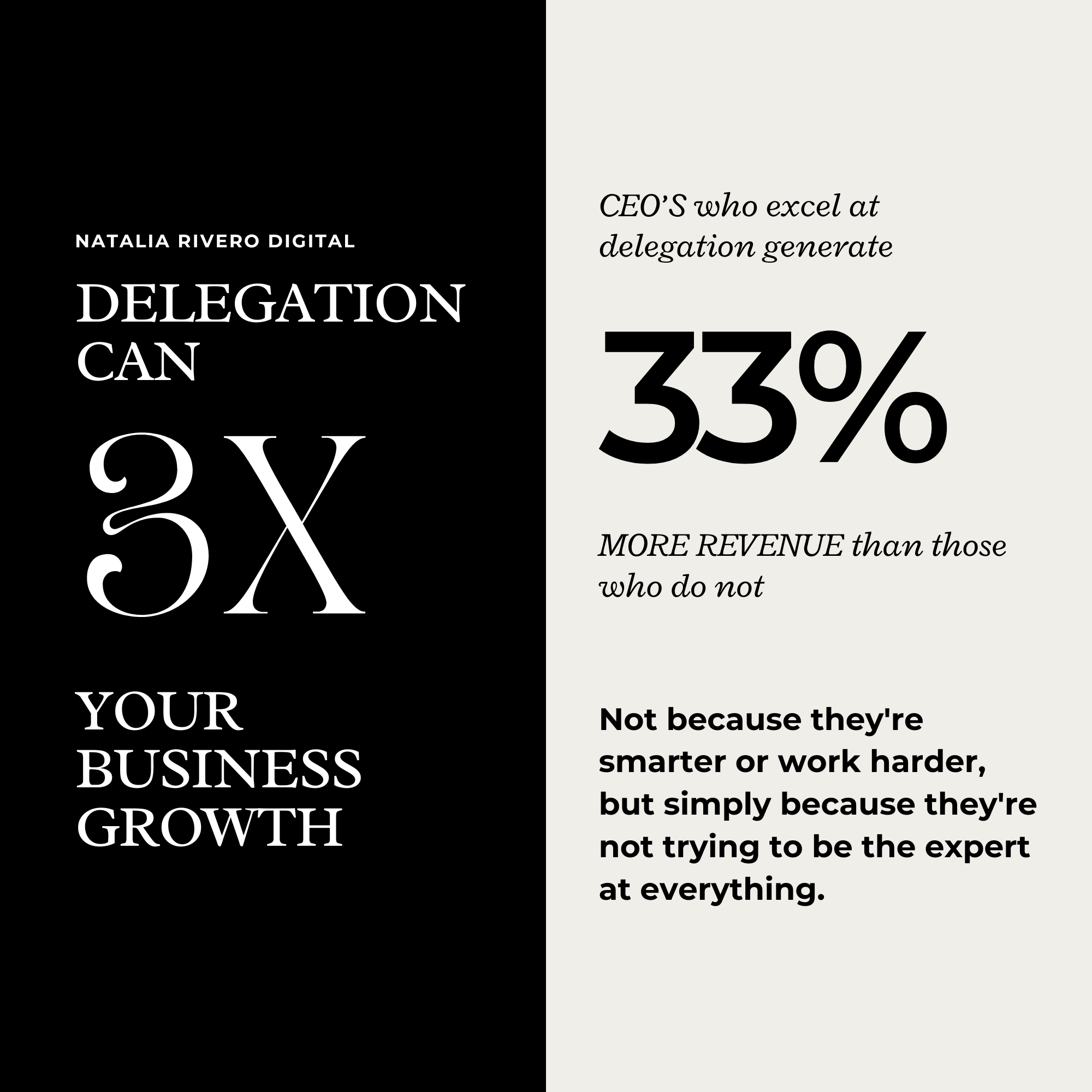
Source: Stop Doing Everything Yourself: How Delegation Can 3X Your Business Growth by Andy Botwin, Strategy People Culture Consulting
So, What’s The Cost of “I’ll Just Do It Myself”?
When you insist on doing everything alone, the outcome is certain: you become the bottleneck in your own business.
Research shows that CEOs who excel at delegation generate 33% more revenue than those who don't. And it’s not because they're smarter or work harder… it’s because they're not trying to be the expert at everything.
But here's what I see happening with the people I work with: they completely overcommit because they think they're the only one who can do it best. They end up taking on way too much.
And the result is always the same: they’re unable to focus on the growth of their business anymore. They can't take new clients on, and they can't even focus on nurturing current relationships.
Commonly, there's also this fear that nobody else cares about their business as much as they do. And you know what? They're right… nobody will care about your business exactly like you do.
But caring differently doesn't necessarily mean caring less.
When Letting Go Works
This happens when someone realises that there are capable people out there whose passion is to help solo founders thrive. When they realise that I treat their business with the same level of excellence and care that I do my own (because if I couldn’t/didn't want to do that, I wouldn't take them on as a client in the first place).
Once they feel confident in my abilities, they relax. They know it's taken care of (whatever it is). They can put their full attention toward the bits of their business where they actually are the expert; providing their service and doing the work that only they can do.
Sometimes 80% done by someone else is infinitely better than 0% done by you. Or 100% done by you at the cost of your strategic priorities.
The question shouldn’t be whether someone else can do it as well as you. The question should be whether you doing it is the best use of your expertise right now.
Maintaining Your Edge Without Losing Your Mind
You have to actively work against your own competence (I know, that probably sounds mad, but hear me out).
Question your assumptions: The things you "just know" are often the things that need the most scrutiny. Your expertise can become a set of invisible blinkers you don't even know you're wearing.
Bring in people who don't think like you: Not just people who are less experienced… you want to bring in people who are experts, but in completely different areas, because they’re able to spot the things you've stopped seeing.
Recognise where perfection actually matters: Take it from a fellow (recovering) perfectionist… not everything needs to be done to your exacting standards. Some things just need to be done, and learning to tell the difference is a skill in and of itself.
Build trust intentionally: If you're going to delegate, for the sanity of both yourself and the person you are delegating to, you need to actually let go. That means accepting that someone else's approach will probably look different from your own, and that’s okay.
And probably the most uncomfortable part; you need to get comfortable with good enough in areas that aren't your area of expertise.

The Paradox Isn’t Going Anywhere
Your expertise will always be both your greatest asset and your biggest vulnerability.
The knowledge that makes you valuable also makes you blind to alternatives. The standards that ensure quality also create bottlenecks. The confidence that helps you lead also makes you resistant to other perspectives. And this isn’t a problem to solve, it’s more of a tension to manage.
You want to know what I’ve noticed? The people who succeed aren’t the ones who completely remove the paradox… they're the ones who recognise it, respect it, and build around it.
They know when to lean into their expertise and when to step back. They can see what needs their particular expertise, and what just needs someone competent who cares.
They've learned that being brilliant at one thing, means accepting you can't be brilliant at everything. That’s not a limitation, it’s just reality.
The question is whether you're going to fight it or work with it.